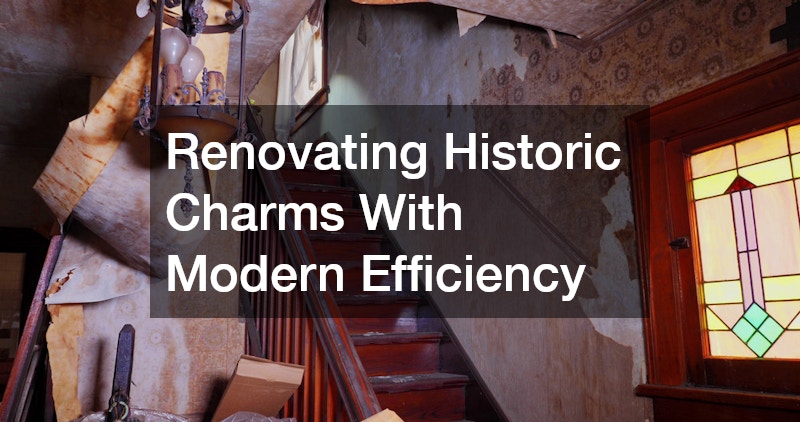
There’s a particular kind of homeowner who falls in love with an older home, knowing full well what they’re getting into. The sloped floors, the radiators that clank at 2 a.m., the single-pane windows that frost over from the inside in January — none of it is enough to override the pull of original hardwood, plaster crown molding, and a front porch that was built to last a century. The problem isn’t the love for the home. The problem is the utility bill.
Older and historic homes are among the most energy-inefficient structures standing today, not because they were built poorly, but because they were built for a different era. Insulation was minimal by modern standards. Windows were single-pane. HVAC systems didn’t exist. And the building envelope — the sum of walls, roof, windows, and foundation — was never designed to meet the airtightness expectations we now consider baseline.
The good news is that modernizing an older home doesn’t mean gutting it. The most effective upgrades are often the least visible ones: better insulation, smarter glass, efficient systems, and cleaner air. This guide walks you through exactly how to approach those upgrades in a way that respects the home’s character while making it genuinely comfortable and cost-effective to live in.
Know What You’re Working With Before You Touch a Wall

Skipping the diagnostic phase is the most common and most expensive mistake historic homeowners make. Before committing to any upgrade, you need an objective picture of where the home is losing energy, where moisture is accumulating, and what hidden conditions might affect your renovation decisions down the line.
Start with a professional energy audit. Most utility companies offer them at low or no cost, and independent energy auditors can provide thermal imaging that shows exactly where heat is escaping through walls, ceilings, and floors. This step alone can redirect thousands of dollars toward the fixes that will actually move the needle.
A thorough pre-renovation walkthrough should cover:
- Attic and crawl space insulation levels and condition
- Foundation sill plates and rim joists for air leakage
- Window and door frame integrity
- Evidence of moisture intrusion or past water damage
- The age and condition of major mechanical systems
Think of this phase as building your project priority list. Not every upgrade delivers equal return, and in an older home with a finite renovation budget, sequencing matters. Seal the building envelope first, then address mechanical systems, then layer in the finishing upgrades.
Seal the Gaps That Are Quietly Draining Your Energy Bills
Older homes leak air at a rate that would fail every modern energy code inspection. Balloon-frame construction, which was standard before the mid-twentieth century, creates continuous wall cavities that run from the basement to the attic — essentially open chimneys for conditioned air to escape. Add in decades of settling, dried-out caulk, and original weatherstripping, and you have a building that breathes far more than it should.
Spray foam insulation is one of the most effective solutions for the irregular, hard-to-access gaps that older homes are full of. Unlike fiberglass batts, which require a clean cavity and precise fitting, spray foam expands to fill whatever space it occupies — around pipes, inside rim joists, behind electrical outlets, and along the irregular edges of older framing. Closed-cell spray foam also acts as a vapor barrier, which matters significantly in climates with high humidity or wide seasonal temperature swings.
For attic and wall cavity work, the scope and complexity of the job usually warrant professional installation. A local insulation company brings advantages that national franchises often don’t: familiarity with regional climate conditions, experience working inside older building structures without causing damage, and knowledge of local preservation codes that may restrict certain installation methods. When interviewing insulation contractors for a historic home, ask specifically about their experience with pre-mid-century construction and whether they’ve worked within any historic district guidelines before.
Key areas to prioritize for air sealing in an older home:
- Rim joists and sill plates along the foundation
- Attic hatch perimeters and pull-down stair frames
- Plumbing and electrical penetrations through floors and walls
- Fireplace dampers and chimney chases
- Gaps around recessed lighting in top-floor ceilings
Choose Window Upgrades That Honor the Architecture and Block the Elements

Original windows are often the most architecturally significant feature of a historic home. Six-over-six double-hung sashes, divided-light casements, arched transoms — these aren’t just functional openings, they’re part of what defines the home’s identity. They’re also, almost without exception, thermal liabilities. Single-pane glass transmits heat and cold directly, and the original glazing compound that held the glass in place dried out decades ago in most cases.
Homeowners considering full window replacement frequently encounter the question of glass performance ratings, and one of the most common points of confusion is the difference between impact windows and hurricane windows. Impact windows refer specifically to the construction of the glass itself — a laminated interlayer between two panes that holds the glass together on impact rather than shattering. Hurricane windows, on the other hand, refer to a certification standard that the entire window unit (frame, hardware, and glass assembly) has passed for wind and pressure resistance. An impact-rated glass unit is not automatically hurricane-certified, and in coastal or storm-prone regions, that distinction matters for both insurance purposes and actual storm performance.
For homeowners in historic districts or those who want to retain original windows, home window tinting service offers a non-invasive middle path. Professional window film applied to existing glass can reduce solar heat gain significantly, block the majority of UV radiation that fades interior furnishings, and add a modest layer of glass reinforcement — all without altering the exterior appearance of the window. In many cases, tinting is the only upgrade that satisfies both a preservation board’s aesthetic requirements and a homeowner’s comfort goals.
Dress Your Windows to Work Harder for Your Home’s Comfort
Once the glass itself has been addressed, the next layer of thermal control comes from the interior. Window treatments are often chosen for aesthetics first, but in an older home with imperfect glazing or single-pane glass that hasn’t been replaced, the right treatment can make a meaningful difference in comfort and energy performance.
Cellular shades, also called honeycomb shades, trap air in their pockets and create a buffer between the cold glass surface and the room. Thermal-lined drapes do the same with mass and density. Interior shutters, particularly plantation or solid-panel styles, align naturally with the architecture of Victorian, Craftsman, and Colonial Revival homes while providing genuine insulating value when closed.
A few practical considerations when selecting treatments for an older home:
- Layer where possible — a sheer for light diffusion combined with a heavier drape for thermal control gives you seasonal flexibility
- Choose floor-length panels over café-length for maximum coverage on tall historic windows
- Consider magnetic interior storm panels as an invisible upgrade that works behind any treatment
- Match hardware finishes to the home’s era to keep the aesthetic coherent
The goal is to treat window dressings as part of the thermal system, not just the décor layer. In a home where full window replacement isn’t feasible or desirable, the combination of film, interior treatments, and weatherstripping can get surprisingly close to the performance of a new window at a fraction of the cost.
Upgrade Your HVAC System Without Gutting Your Historic Interior

Forced-air HVAC systems require ductwork, and running ductwork through an older home that was built without it is one of the most invasive and potentially damaging things you can do to original plaster, period millwork, and finished floors. Dropped soffits, widened walls, and cut floor joists are common casualties of poorly planned HVAC retrofits in historic homes.
Ductless mini-split systems have become the preferred air conditioning solution for older homes precisely because they don’t require any of that. An outdoor compressor unit connects to one or more indoor air handlers through a small conduit that passes through an exterior wall. There’s no ductwork, no dropped ceiling, and no structural disruption. Modern mini-splits are also highly efficient, with many units operating at SEER ratings well above current code minimums.
Working with a qualified HVAC contractor who has specific experience in historic and older homes is not optional — it’s the variable that most directly determines whether the project goes smoothly. An experienced contractor will assess the home’s existing envelope performance before sizing equipment, because an older home that has been air-sealed and insulated properly requires significantly less HVAC capacity than the same home left unaddressed. Oversized systems short-cycle, wear out faster, and fail to dehumidify effectively.
When evaluating HVAC options for an older home, ask about:
- High-velocity mini-duct systems, which use flexible small-diameter tubing that threads through existing cavities with minimal demolition
- Zoning configurations that address the uneven heating and cooling loads common in multi-story historic structures
- Heat pump options that provide both heating and cooling from a single system
- Integration with existing radiator or radiant systems where those are still functional
Don’t Let Aging Appliances Undermine Your Efficiency Gains
Sealing the envelope and upgrading the HVAC system can reduce a home’s energy consumption significantly, but those gains are partially offset if the refrigerator from the early aughts is running around the clock at twice the energy draw of a current model. Appliances are easy to overlook in a renovation focused on building systems, but they represent a consistent and measurable draw on energy resources.
The case for appliance repair is strongest when a unit is structurally sound but has a specific, diagnosable issue: a worn door gasket on a refrigerator, a clogged lint pathway in a dryer, a faulty igniter on a range. These are inexpensive repairs that restore efficiency without the cost or waste of full replacement. A simple decision framework: if the repair cost is under half the replacement value and the unit is relatively recent, repair generally wins. If the unit is pushing well past its expected lifespan and the repair cost is high, replacement with an ENERGY STAR-certified model typically delivers better long-term value.
Test Your Indoor Air Before and After Major Renovations

Renovation work in older homes carries risks that newer construction simply doesn’t. Lead paint was used in virtually all homes built before the late seventies. Asbestos was a common component of insulation, floor tiles, and joint compound through the mid-eighties. Disturbing these materials during demolition or wall-opening work releases particles that don’t show up on any visual inspection.
Scheduling air quality testing services before any significant demolition work begins establishes a baseline and identifies what’s present in the home. Post-renovation testing confirms that disturbance work was handled properly and that the home is safe to occupy. Some municipalities require air quality clearance before issuing final permits on older structures, so this step may not be optional depending on your location.
A comprehensive air quality test typically screens for:
- Asbestos fibers and lead dust following any demolition
- Mold spores, particularly after opening walls in older structures
- Radon levels, especially in homes with basements or crawl spaces
- VOCs from new paints, adhesives, and finishes applied during renovation
- Particulate matter and carbon monoxide from combustion appliances
Keep copies of all test reports! They’re valuable documentation for insurance purposes and for any future sale.
Work With a Renovation Partner Who Understands Historic Properties
The contractor who built the new subdivision down the road is not necessarily the right person to touch a century-old Craftsman bungalow. Older homes require a different skill set, a different material vocabulary, and a fundamentally different approach to problem-solving. What looks like a simple drywall patch in a new build is a plaster-matching challenge in a historic one.
Specialized home renovation services with a demonstrated portfolio in period-correct restoration bring a level of material knowledge and structural sensitivity that generalist contractors typically don’t. Look for a contractor who understands lime-based mortars, original-growth lumber, and the difference between stabilizing historic features and simply replacing them. Ask to see completed projects on homes of a comparable age and style, and verify that they’ve navigated local historic district approvals before.
Before signing any contract, investigate whether your property qualifies for state or federal historic preservation tax credits. Many states offer meaningful credits on qualified rehabilitation expenses, and the federal Historic Tax Credit program applies to income-producing historic properties. The right renovation partner will be familiar with these programs and can help structure the project scope to take full advantage of them.
An older home that’s been thoughtfully upgraded doesn’t just perform better — it tells a more complete story. The bones that survived a century of use are still there. The hardware, the millwork, the proportions that no new build can replicate — those remain. What changes are the monthly cost of living inside it, the air quality on a winter morning, and the consistency of the temperature from room to room?
Modern efficiency and historic character are not in conflict. They never were. The tension was always between doing the work properly and doing it cheaply. Invest in the right sequence, the right trades, and the right materials, and an older home can outperform many new builds on comfort and efficiency while holding something new construction simply can’t offer: the sense that it was made to last.